
7 Hip Stability Exercises That Support Long-Term Joint Health
Your hips do more work than most people give them credit for. Every step, squat, stair climb, and change of direction runs through this joint, and the muscles surrounding it are the difference between movement that holds up and movement that gradually breaks down.
The frustrating part is that hip instability tends to develop quietly, often leaving people wondering why their hips feel so tight, showing up first as tightness somewhere else, a little wobble on one leg, or a nagging ache that never quite goes away. By the time it gets louder, compensation patterns are already well underway.
These 7 hip stability exercises that support long-term joint health were chosen specifically to address the deep control and coordination your hips depend on most. They are not about building a bigger glute or hitting a new personal record. They are about training your body to move with the kind of precision that keeps your joints healthy, your movement clean, and your body genuinely reliable for the long run.
Recognizing When Hip Stability Starts To Slip (& Why It Matters)
Most people do not think about their hips until something starts to hurt. The hip joint is one of the most relied-upon structures in the entire body, involved in virtually every movement you make. When the muscles surrounding it stop doing their job well, the effects travel quickly through your whole system.
Discomfort in the knees, tension in the lower back, and unpredictable balance are often traced back to this single, central region. Catching the early signs and addressing them with intention is far more effective than managing the consequences later.
How Hip Stability Impacts Your Knees And Low Back
Your hips sit at the center of the kinetic chain, connecting your lower body to your spine and everything above it. When the muscles controlling the hip joint are underactive or poorly coordinated, neighboring joints absorb load they were never designed to handle.
The knee is especially vulnerable because it depends on the hip above and the ankle below for proper alignment and support. An unstable pelvis alters the tracking of the femur, which places uneven stress directly on the knee joint over time.
The lower back faces a similar challenge, as the lumbar spine compensates when the glutes fail to stabilize the pelvis during movement. These compensations feel minor at first, but they accumulate steadily and eventually become difficult to ignore.
Why Joint Health Depends On Control
Strength alone is not enough to protect a joint, and that distinction matters more than most people realize. A muscle can be strong in isolation and still fail to activate at the right moment during a real movement pattern. Joint health depends on neuromuscular control, which is the ability of the right muscles to fire at precisely the right time.
Without that timing and coordination, even a well-conditioned body can move in ways that wear down cartilage and overload passive structures.
Control is built through deliberate, progressive training that teaches the body how to manage load and position together. That is what differentiates a joint that lasts from one that gradually breaks down.
Subtle Signs Of Instability You Shouldn't Ignore
Hip instability rarely announces itself loudly at the start, and that is what makes it easy to overlook. The signs tend to show up quietly, in small deviations from how you used to move with ease.
A knee drifting inward during a squat, a slight hip hike when walking up stairs, or a feeling of wobble on one leg are all worth paying attention to. Tightness in the IT band or recurring soreness along the outer hip are also common signals that something upstream is not functioning well.
Fatigue in the lower back after activities that should feel comfortable is another pattern that points toward the hips. None of these symptoms is dramatic on its own, but together they paint a clear picture worth addressing.
Strengthening Hips Is Not The Same As Stabilizing Them
This is one of the most common misconceptions in movement training, and it leads people in the wrong direction regularly. Strengthening a muscle increases its force production capacity, but it does not automatically teach that muscle to activate with precision during functional tasks.
Someone can have genuinely strong glutes and still display significant instability during single-leg movement or weight transfer. Stability training specifically targets the neuromuscular system, building the body's ability to control position and respond to load in real time.
It requires lower-threshold, highly controlled movements that demand attention and precision rather than effort and intensity. Both qualities matter and both deserve dedicated attention, but they require very different training approaches to develop.
7 Hip Stability Exercises For Long-Term Joint Health
The following seven exercises are designed to build the deep control and coordination that the hip joint depends on most. They progress from foundational isolation work into more demanding, functional movement patterns over the course of the list.
Each one has a specific purpose within the bigger picture of restoring and maintaining hip stability. Work through them in order, give each one the attention it deserves, and let the quality of movement lead every single repetition.
#1) Side-Lying Leg Raises With Pelvic Control
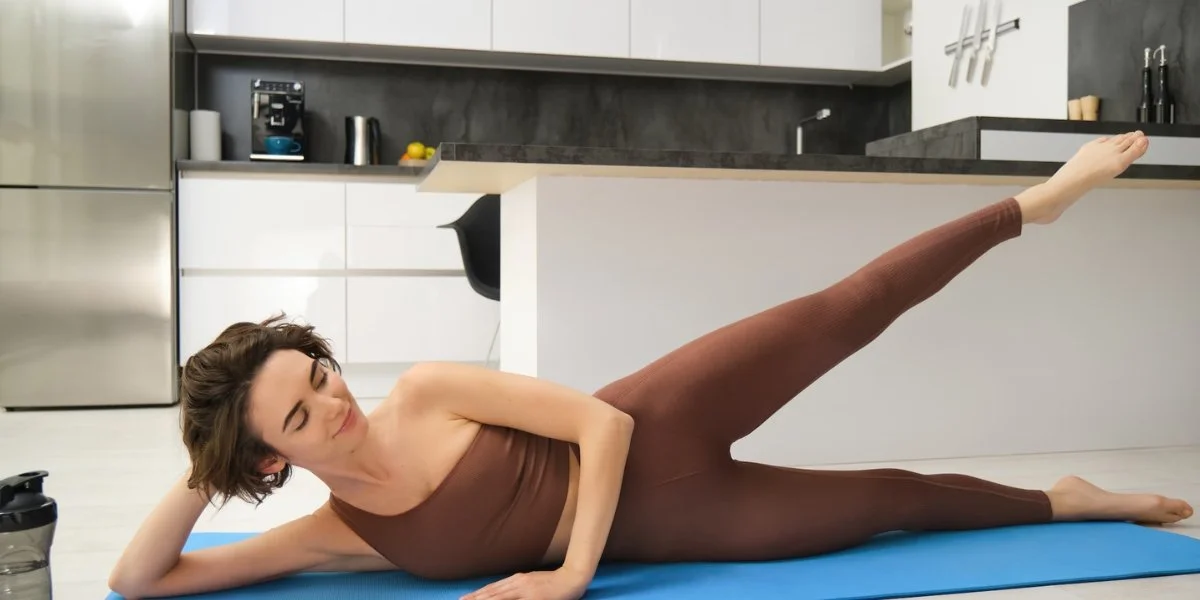
This exercise is one of the most reliable starting points for reactivating the gluteus medius with precision and awareness. Lie on your side with your body in a straight line, hips and shoulders stacked directly on top of each other. Rest your head on your bottom arm and place your top hand on the floor in front of your chest for light support.
On your exhale, lift the top leg to roughly hip height, keeping the foot in a neutral or slightly downward-angled position. The pelvis must stay completely still throughout the lift; any rolling backward or forward is a compensation to correct.
Lower the leg slowly and with full control, resisting the pull of gravity on the way down. Perform 10 to 12 repetitions per side, prioritizing clean pelvic position over leg height at all times.
#2) Clamshell Variations With Rib And Hip Alignment
The clamshell is a foundational hip stability exercise that directly targets the gluteus medius and external rotators. Lie on your side with your hips bent to about 45 degrees and your knees bent to 90 degrees, feet stacked together.
Draw your lower ribs gently in and stack your hips precisely, making sure the top hip does not drift backward as the knee opens. On your exhale, rotate the top knee upward while keeping both feet together and the pelvis absolutely still. Open only as far as you can without the hip rolling back, as range is far less important than control here.
For a progression, add a light resistance band just above the knees to increase demand on the glute med, similar to how hip flexor band exercises use resistance to build control and stability. Complete 10 to 15 controlled repetitions per side before switching.
#3) Single-Leg Balance With Forward Reach
Single-leg work is where hip stability reveals itself clearly, and this exercise is an honest and effective test. Stand on one foot with a soft bend in the standing knee, keeping your hips level and your gaze fixed forward.
Slowly reach the opposite leg forward, out to the side, and then behind you, tapping lightly at each point if possible. The standing hip must control pelvic position throughout all three directions of reach without dropping or rotating. Start without reach if balance is limited, simply standing on one leg for 20 to 30 seconds with controlled breathing.
Progress to the reach pattern once single-leg balance feels genuinely stable and controlled. Three rounds of five to eight reps per direction on each leg is a strong working target.
#4) Lateral Step Downs For Frontal Plane Control
Step-downs train the hip stabilizers in one of the most demanding positions the body regularly encounters in daily life. Stand on a step or a low box with one foot, the other leg hanging freely beside it in the air.
With control, bend the standing knee and slowly lower the free foot toward the floor without letting it fully rest. The standing knee must track directly over the second and third toes without collapsing inward at any point. Your pelvis should stay level throughout the descent rather than dropping toward the unsupported side.
Press firmly back through the standing heel to return to the starting position, keeping the glutes actively engaged. Begin with a very small box height and only increase it once your mechanics are consistently clean.
#5) Split Stance Holds With Stacked Alignment
The split stance hold trains the deep stabilizers to manage an asymmetrical load, which is exactly what walking and stair climbing demand. Stand with one foot forward and one foot back in a comfortable split stance, feet roughly hip-width apart in width.
Stack your hips squarely below your pelvis and find a tall, neutral spine from the tailbone to the crown of the head. On your exhale, gently lift through the pelvic floor and draw the lower abdominals in lightly together. Both knees maintain a soft bend, and neither hip rotates or hikes throughout the hold.
Hold for four to six full breath cycles, then switch the leg position and repeat on the other side. This exercise is deceptively simple and highly effective at building the foundational control that more complex movements require.
#6) Single-Leg Romanian Deadlift For Hip Hinge Stability
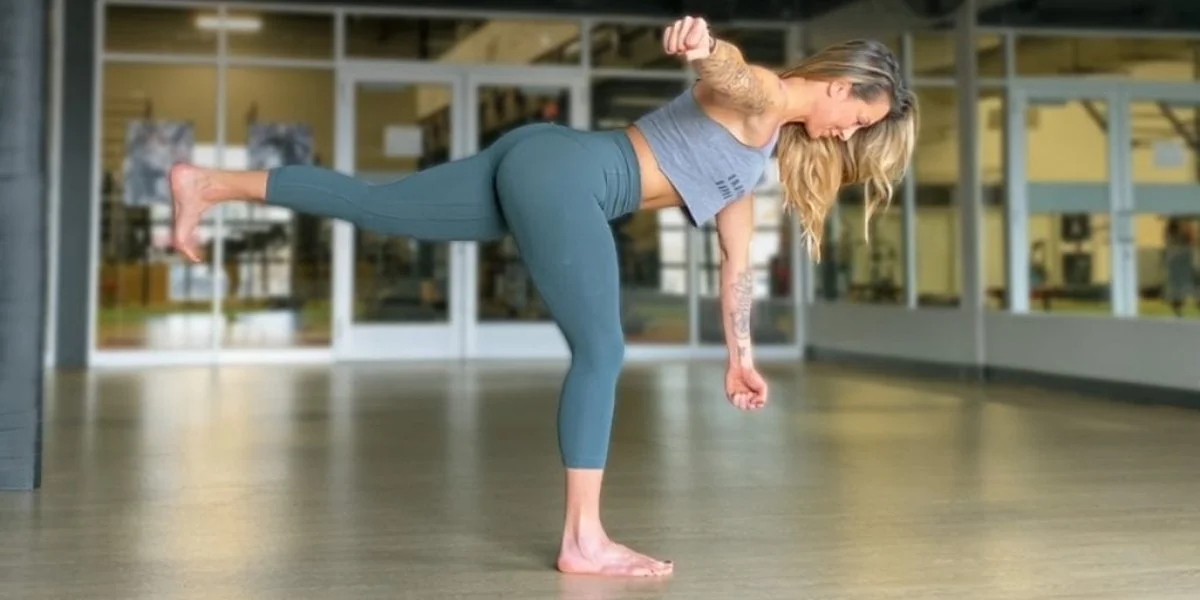
The single-leg Romanian deadlift builds hip hinge control, posterior chain strength, and rotational stability all at once. Stand tall on one foot, with a very soft bend in the standing knee and the hips square to the front.
Begin to hinge forward at the hip, sending the free leg back behind you as a counterbalance while the torso lowers. Keep the spine long and neutral throughout, resisting any twisting or rounding through the mid and lower back. Lower until the torso is roughly parallel to the floor or until the back begins to round, whichever comes first.
Press through the standing heel and contract the glute firmly to return to an upright position. Begin with bodyweight only and add a light load in the opposite hand once the movement pattern is genuinely clean and controlled.
#7) Standing Cable Rotation For Rotational Control
Rotational stability is one of the most overlooked components of hip function, and this exercise addresses it directly. Stand sideways to a cable machine or anchor point with a light resistance band, holding the handle with both hands at chest height.
With your feet hip-width apart and knees slightly bent, rotate your torso away from the anchor in a slow and controlled arc. The hips and pelvis remain completely still throughout the rotation; only the thoracic spine moves with purpose. Resist the pull of the cable as you return to center, controlling the deceleration phase as carefully as the rotation itself.
The standing hip stabilizers work continuously throughout this movement to keep the pelvis from shifting or rotating along with the torso. Begin with very light resistance, focus entirely on pelvic control, and build load only as mechanics stay clean.
How To Improve Hip Stability Over Time
Improving hip stability is not a destination you arrive at after a few sessions; it is an ongoing process of refinement. The body responds to consistent, well-structured training over weeks and months, not days.
Progress looks like cleaner mechanics, greater confidence in single-leg tasks, and fewer compensations during movement. Patience and quality are the two non-negotiables here, as rushing this kind of work consistently undermines it.
Developing A Sustainable Hip Stability Routine With Professional Guidance
Building a reliable, long-term hip stability routine is far more effective with expert support guiding the process. A skilled trainer can identify where your specific compensations are occurring and build a program that addresses them precisely.
Without that kind of assessment, it is easy to train hard and miss the actual issue entirely, reinforcing poor patterns instead of correcting them. Professional guidance removes that guesswork, ensuring your time and effort translate directly into measurable progress.
At The Pilates Circuit, every program starts with an honest look at how you move and builds from there with genuine intention. The goal is a body that moves well, loads cleanly, and holds up reliably through everything life asks of it.
Closing Thoughts: Stable Hips Protect Your Future Movement
The hips are the foundation of nearly every meaningful movement your body makes, from the most basic to the most athletic. When that foundation is solid, everything built on top of it works better, longer, and with far less wear.
The work of building hip stability is quiet and often unglamorous, but its impact runs through every layer of physical life. Better balance, a more resilient lower back, healthier knees, and greater confidence in movement are all outcomes that build steadily over time.
Starting this work now, at whatever level is right for your body today, is one of the most forward-thinking investments you can make.
Get Started Today
Transform your fitness with Private 1x1 Pilates in NYC. At The Pilates Circuit, we deliver personalized one-on-one training designed around your body, your goals, and your progression. Whether you're improving posture, building strength, or enhancing mobility, every session is structured to drive measurable results.
Book an Intro Session to experience how targeted training can make a difference. Train with us at our Chelsea Private Pilates Studio or NOMAD Private Pilates Studio.
Frequently Asked Questions
-
The most effective hip stability exercises target the gluteus medius, deep external rotators, and the body's ability to control pelvic position under load.
Side-lying leg raises, clamshells, single-leg balance work, and lateral step downs are among the most reliable foundational options. As strength and control develop, more complex patterns like single-leg deadlifts and rotational cable work become valuable additions to the program.
The best individual selection will always depend on where your instability is occurring and what your current movement baseline actually is.
-
Two to three dedicated sessions per week is a very effective and sustainable frequency for most people beginning this kind of training.
At this frequency, the body receives enough stimulus to adapt while still having adequate time to recover between sessions. Hip stability work can also be incorporated into a broader strength or Pilates program, especially when using Pilates for hip pain, rather than being treated as a completely separate practice.
Consistency across several weeks matters far more than any single session, so building a routine you can maintain reliably is the priority.
-
Common signs include a knee drifting inward during squats or lunges, recurring tightness along the outer hip or IT band, and difficulty balancing on one leg with control.
A hip that drops or rotates during walking, stairs, or single-leg movements is another reliable indicator of instability. Lower back fatigue during activities that should feel routine is also worth noting, as it frequently points to underactive hip stabilizers upstream.
A movement assessment with a qualified trainer or movement professional is the clearest and most reliable way to get an accurate picture of what is actually happening.
