
6 Postpartum Abdominal Exercises That Restore Core Stability
Quick Overview: Starting Postpartum Abdominal Exercises
- Postpartum abdominal exercises should reconnect breathing, deep core support, and pelvic floor coordination before adding greater intensity.
- The right starting point depends on your recovery, delivery, symptoms, and ability to manage pressure during movement.
- The six exercises progress from foundational breathing to controlled floor work, standing stability, and integrated core support.
- This guide explains how to perform each exercise, what readiness can look like, and when a movement needs modification.
Nobody warns you quite enough about what happens to your core after having a baby. You can feel it in the way you move, the way your back responds, and the way exercises that once felt automatic suddenly feel completely foreign.
That is not a weakness, and it is not a permanent state. It is your body asking for a specific kind of attention that general fitness simply does not address. The 6 postpartum abdominal exercises in this guide were chosen with exactly that in mind.
They work from the inside out, reconnecting the deep muscles that pregnancy and birth inevitably disrupt: no crunches, no shortcuts, and no pressure to perform before your body is genuinely ready.
Your Core Feels Different After Birth For A Reason
Giving birth changes your body in ways that go far deeper than what you can see on the surface. The muscles, connective tissue, and pressure systems inside your core all shift significantly during pregnancy and delivery.
This is not a cosmetic issue, and it is not solved by simply working harder or pushing through. Understanding why your core changed after birth is the first real step toward rebuilding it well.
When "Bouncing Back" Misses The Point
The phrase bouncing back sets up an impossible and frankly unfair standard for new mothers. It implies that your body before pregnancy was the goal, and that everything after is somehow a setback.
What pregnancy actually does is ask your body to reorganize itself completely for nine months. The ligaments loosen, the abdominal wall stretches, the pelvic floor bears an enormous load, and the diaphragm shifts. Returning to your old routine and expecting the same physical response simply will not work.
What your body needs now is not a reversal but a thoughtful, intentional rebuild from the inside out.
Rebuilding Strength Starts With Stability
Before your body can handle a load, it needs to relearn how to manage pressure and organize itself first.
Stability is the foundation; adding strength on top of it without it creates more dysfunction than genuine progress. The deep core muscles need to reconnect and coordinate before any external load is introduced. This means starting with breath, alignment, and controlled movement rather than crunches or heavy exercise.
Stability-first training protects the pelvic floor, supports the healing of the linea alba, and builds lasting strength over time. Many deep core exercises for women use this same stability-first approach before progressing to more demanding movement.
What Does Core Stability Look Like After Giving Birth?
Core stability after birth looks very different from what most people picture when they hear the word core. It is not about a flat stomach or a visible six-pack, and it never starts there.
True core stability means your deep internal muscles are firing, coordinating, and managing pressure effectively together. It shows up in how you carry your baby, how your back feels, and how you move through everyday life.
When the deep system is working well, everyday tasks feel supported rather than strained and precarious.
The Deep Muscles That Support You
Most people know the rectus abdominis, the muscle that creates the visible six-pack shape on the surface. But underneath that are deeper layers of muscle that actually run your entire internal stability system.
The transverse abdominis wraps around your trunk like a corset and is your deepest abdominal muscle. It works alongside the pelvic floor below, the diaphragm above, and the multifidus muscles along your spine.
Together, these four structures form the deep-core canister, which functions as a single unit. During pregnancy, the canister is disrupted as all four components stretch, shift, and change under load. Postpartum abdominal exercises that restore core stability work by reconnecting and retraining this system from the inside, much like well-structured pilates ab exercises that focus on deep core engagement and controlled movement.
More individualized postpartum Pilates for core recovery can help guide that rebuilding process more safely by focusing on pressure management, pelvic stability, breathing mechanics, and gradual strength progression rather than rushing back into high-intensity exercise.
Many pilates moves strengthen pelvic floor function while helping restore coordination after pregnancy and childbirth.
6 Postpartum Abdominal Exercises That Restore Core Stability
Each of the following exercises has been selected to restore the deep core system progressively after birth, much like the structured progression used in pilates reformer core exercises designed to rebuild stability and control. They build on one another, moving from foundational breathwork to more coordinated, controlled movement patterns.
Go in sequence, master each exercise fully, and never rush the progression forward. Your body will tell you when it is ready to move on, and patience here genuinely pays off.
#1) Supine 360 Rib And Pelvic Breath For Deep Core Reset
Breath is the entry point to every postpartum core exercise, and this one is fundamental to everything that follows. Lie on your back with your knees bent and feet flat, arms resting comfortably at your sides. Inhale deeply through your nose and allow your rib cage to expand fully in all directions.
As you breathe in, feel the rib cage widen sideways, the belly soften, and the pelvic floor gently release. On your exhale, draw the lower ribs down and in while the pelvic floor lifts softly and with control. Your lower back stays neutral throughout, neither pressing hard into the mat nor arching away from it.
This exercise reestablishes coordination among your diaphragm, pelvic floor, and transverse abdominis. Start with 8 to 10 slow, connected breaths and build from there as your awareness develops.
#2) Neutral Pelvis Heel Slides With Rib Stability
This exercise builds on the breathwork from the first and adds a gentle demand on the lower abdomen. Begin lying on your back with knees bent, feet flat, and your pelvis in a neutral position. A neutral pelvis means there is a small, natural curve in your lower back, not pressed flat.
Take ya gentle exhale to activate the deep core, then slowly slide one heel along the floor. Extend the leg fully without tilting your pelvis or lifting your lower rib.
Inhale as you return the leg, maintaining control throughout the full range of motion. Alternate legs for 8 to 10 repetitions per side, keeping your attention on your pelvis throughout.
#3) Tabletop Toe Taps With Abdominal Control
Once heel slides feel completely steady and controlled, tabletop toe taps are the natural next progression. Lie on your back and bring both knees to a 90-degree tabletop position directly above your hips.
On your exhale, gently engage the deep core and slowly lower one foot toward the floor. Tap the toes lightly, then return the leg on your inhale, keeping the pelvis completely still throughout. The challenge is keeping your lower back from arching as your leg lowers away from your body.
If you feel your back lifting or your ribs flaring, this movement is currently too demanding for your core. Return to heel slides until your connection is stronger before trying this exercise again.
#4) Side-Lying Core Press For Rotational Stability
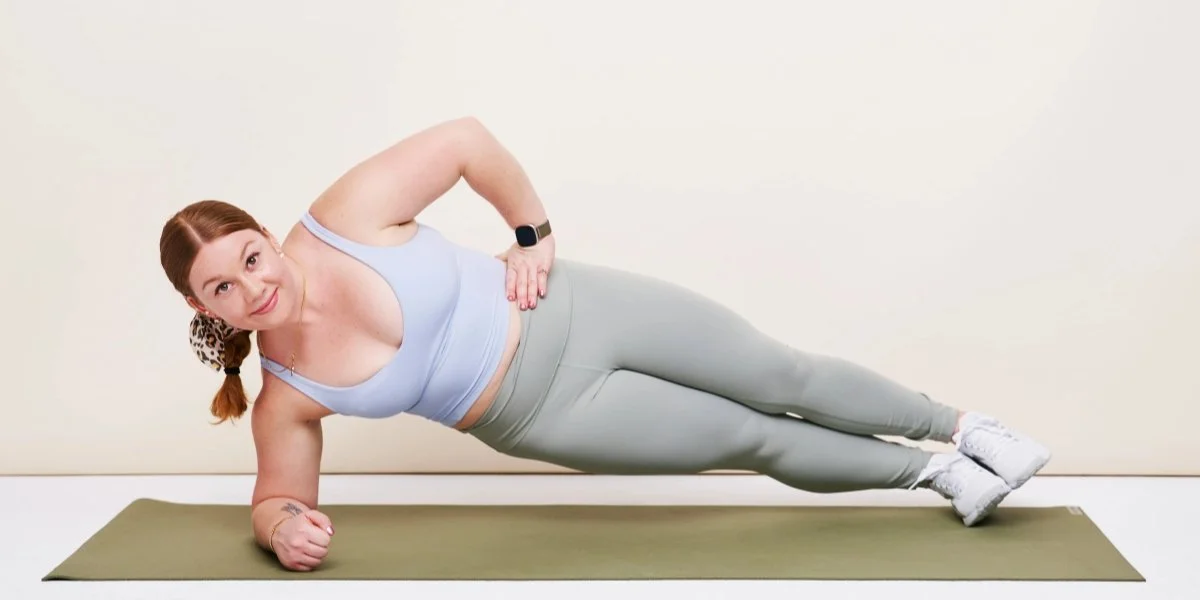
This exercise shifts the challenge away from the supine position and begins to train the rotational stability system. Lie on your side with your hips and shoulders stacked and knees gently bent at about 45 degrees.
Place your top hand flat against your top knee and apply gentle, equal pressure with both hands. Your knee presses into your hand, your hand presses back into your knee, and neither moves at all. This isometric contraction activates the obliques and deep stabilizers without any twisting or spinal flexion involved.
Hold the press for a full breath cycle, exhaling completely, then release and repeat for 8 to 10 reps. Switch sides and give equal attention to both, as strength differences between sides are very common postpartum.
#5) Supported Split Stance Hold With Stacked Alignment
This exercise begins to bring you into a vertical position and challenges core stability in a genuinely functional way. Stand facing a wall or sturdy chair and place both hands lightly on it for support. Step one foot forward and one foot back into a comfortable split stance, feet roughly hip-width apart.
Stack your hips squarely, soften both knees slightly, and find length through the very top of your head. On your exhale, gently draw up through the pelvic floor and in through the lower abdomen together.
Hold for three to five full breath cycles, focusing on keeping the pelvis level and the ribs settled down. This trains the deep core to activate in the positions your body uses throughout a real day.
#6) Glute Bridge With Deep Core Integration
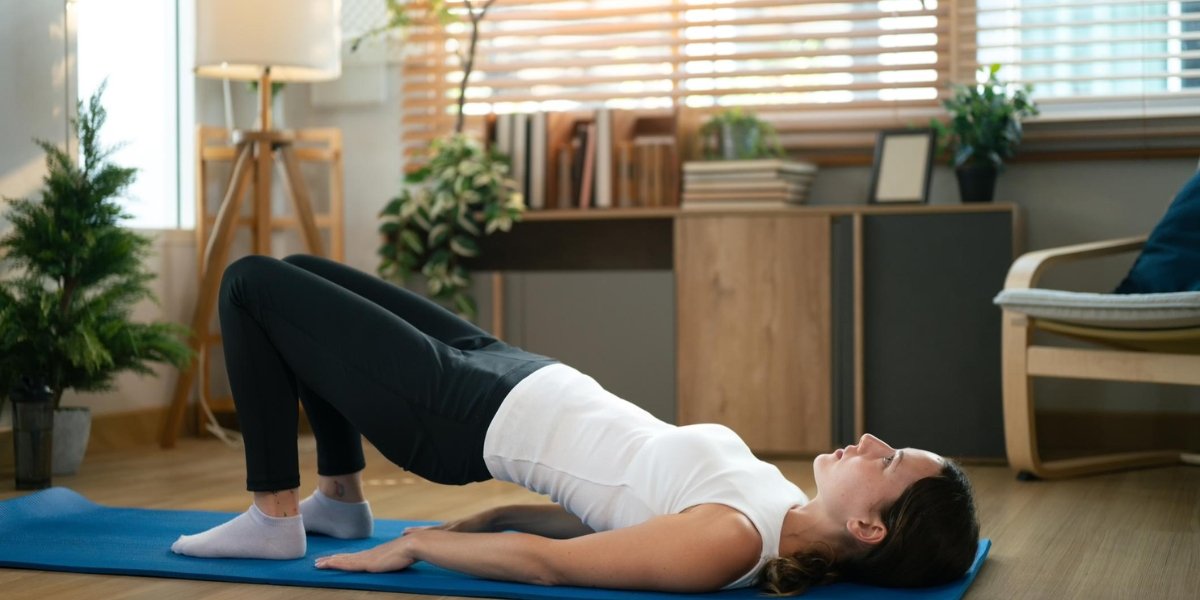
The glute bridge is one of the most accessible and effective exercises in postpartum core recovery for good reason. Lie on your back, knees bent, feet flat on the floor, and arms resting alongside you.
On your exhale, activate the deep core and pelvic floor, then press up through your feet to lift. Lift your hips until your body forms a straight line from your knees to your shoulders. Pause at the top for a full exhale, keeping the glutes active and the pelvis completely level.
Slowly lower back down on your inhale and repeat for 10 to 12 controlled repetitions. The glute bridge connects the posterior chain to the deep core, a pairing that builds real full-body stability over time.
Tips Before Starting Postpartum Abdominal Exercises
Before you begin any postpartum core work, a few practical considerations will set you up for real success.
These are not warnings meant to scare you away from moving; they are simply smart and sensible preparation. Getting clearance from your healthcare provider before starting exercise after birth is always a wise first step.
Once cleared, begin gently and always listen honestly to what your body is actually communicating to you.
Signs You're Ready To Progress
Progressing in your postpartum core training is not about a fixed timeline; it is about genuine physical readiness.
You are likely ready to add complexity when your current exercises feel completely controlled and no longer challenging. Signs of readiness include breathing freely, no pelvic pressure, and full stability through your current exercise level.
If you can hold a neutral pelvis through 10 clean repetitions without strain, that is a reliable green light. Progress one variable at a time, whether that is range of motion, repetitions, or a change in position.
When To Pause Or Modify
Certain physical signals mean your body is asking you to slow down, and they deserve your full attention. If you notice doming or coning along the midline of your abdomen during any exercise, stop and modify immediately.
Doming typically indicates that intra-abdominal pressure exceeds what your core can manage at that recovery point. Leaking, heaviness in the pelvic floor, or pain at the pubic bone are all clear signs to stop the movement. None of these means you cannot train; they mean you need a more graduated and supported starting point.
Working with a knowledgeable trainer who understands postpartum recovery can make that kind of adjustment far simpler.
Closing Thoughts: Prioritizing Stability Now Builds Strength Later
Your core has been through something significant, and giving it proper time to recover is a genuine act of care for yourself. Stability is not the less exciting version of strength; it is the version that actually holds up over time.
The women who invest in this foundational work feel the difference not just in training but in everything they do daily. They lift their children without back pain, move through the day with ease, and feel genuinely strong in their bodies. The work done at this stage is not a detour from fitness; it is the very foundation of it.
Get Started Today
Transform your fitness with Private 1x1 Pilates in NYC. At The Pilates Circuit, we deliver personalized one-on-one training designed around your body, your goals, and your progression. Whether you're improving posture, building strength, or enhancing mobility, every session is structured to drive measurable results.
Book an Intro Session to experience how targeted training can make a difference. Train with us at our Chelsea Private Pilates Studio or NOMAD Private Pilates Studio.
Frequently Asked Questions
-
For mothers wondering how soon can you exercise after birth, gentle breath-based work such as the 360 rib breath can often be started within the first few days after delivery. More progressive movement, including heel slides and tabletop work, typically comes later once you feel physically settled. For vaginal deliveries, many women begin structured core work around 6 weeks after receiving provider clearance.
Cesarean recovery requires additional time due to the abdominal incision, and clearance timelines will typically extend further. Always follow your healthcare provider's guidance and start with what genuinely feels right for your body.
-
The most effective postpartum core exercises work from the inside out, beginning with breath and progressing to load. Diaphragmatic breathing, heel slides, tabletop toe taps, and glute bridges are among the most reliable foundational options.
They collectively address the deep core canister, the pelvic floor, and the posterior chain, working together as a system. The best program for any individual will always depend on their recovery stage, birth type, and physical history.
-
In the early weeks, shorter,d more frequent sessions tend to work far better than longer, less frequent ones. Starting with 10 to 15 minutes of breath and stability work daily is a smart and sustainable approach.
As strength and coordination return, 2 to 3 focused sessions per week become a very effective training structure. Consistency over time is what drives real recovery, not intensity or duration in any single workout.
